| Truth in Media Global Watch Bulletins |
TiM GW Bulletin 2000/6-11 June 27, 2000 |
Mayor
LaGuardia and “Balkans Requiem,” Plus... Fleecing Greece: The €uro vs. the Cross Burns’ Ire on Fire Burns U.S. Diplomat’s Cool; APPENDIX A: Phantom Terror |

FROM PHOENIX, ARIZONA BALKAN
AFFAIRS
BALKAN
AFFAIRS
HEADLINES
New York
1.
Mayor LaGuardia and “Balkans Requiem”
Athens 2.
Fleecing Greece: The €uro
vs. the Cross
New York 3.
Burns’ Ire on Fire Burns U.S. Diplomat’s Cool
New York 4.
APPENDIX A: Phantom Terror
-------------
1.
Mayor LaGuardia and “Balkans Requiem”
NEW YORK, May 24, 1939 - As the New York City mayor, Fiorello LaGuardia, opened the Yugoslav pavilion at the World Fair in New York on May 24, 1939, he said:
"The
people of Yugoslavia are generous, kind and peace-loving.
Whenever there is trouble in the Balkans, it will come from
without, not from within. Let
the strong and big nations leave the Balkans alone, and peace will prevail
there."
Of course, the big powers never
do leave the Balkans alone for long.
Which is why there are always wars in the Balkans.
For which the Balkans people, and not the big powers, are always
blamed. By the big powers, of
course.
“Our goal must be to
debalkanize the Balkans,'” Bill Clinton said on June 3 in Aahen,
Germany, as the American president received the Charlemagne award for
building the “peace” in Europe, a year after bombing the Balkans to
smithereens (see “Toward
a Globalist European Empire”).
“Debalkanize the Balkans?”
Especially after waging war on it.
Dream, fool, dream… This Georgetown/Oxford scholar evidently
hasn’t learned a thing from reading history - the end of the Ottoman
Empire; the Austro-Hungarian Empire; the German Kaiser; the Third Reich...
Not even from Stalin whom Yugoslavia gave the boot in 1948.
If only the graves of empires
could sing. A “Balkans
Requiem” would produce the world’s loudest choral crescendo.
LaGuardia heard it. But not the tone-deaf would-be emperors. Theirs is to do and die… Ours is to explain why.
------------
2.
Fleecing Greece: The €uro vs. the Cross
ATHENS, June 25 - Some people are torn between good and evil. Others are having to choose between traditions and modernity. Yet others are forced to decide if material wealth is worth the price of personal dignity. All such people feel as if they are between a rock and a hard place. Which is the beauty of life. Choices, choices…
Enter Greece 2000… an Olympic-size battlefield where the mighty €uro - representing Globalism and Nihilism, is facing off against the Orthodox cross - symbolizing Christianity and Hellenism.
If the €uro wins in the long run, a Fleece-Greece Feast by the Globalist Beast is sure to follow, just as it has in so many other countries around the world. If the cross prevails in the end, deep fissures within the European “Union” will become discernible even to the most gullible of New World Order “liberals.”
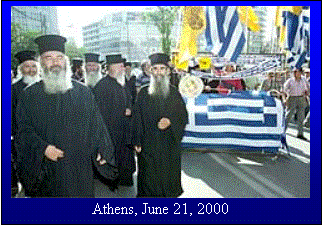 The battle lines between materialism and
spirituality/traditions were sharply drawn last Wednesday (June 21), when
Orthodox church leaders gathered hundreds of thousands of protesters in
the Athens streets, carrying Greek flags and crucifixes to protest against
the €uro. Or to be
more precise, against the Greek government’s decision to remove
religious affiliation from state identity cards, a condition the European
Union imposed before admitting Greece to the €uro monetary union two days earlier (June 19).
It was the second mass demonstration this month.
The battle lines between materialism and
spirituality/traditions were sharply drawn last Wednesday (June 21), when
Orthodox church leaders gathered hundreds of thousands of protesters in
the Athens streets, carrying Greek flags and crucifixes to protest against
the €uro. Or to be
more precise, against the Greek government’s decision to remove
religious affiliation from state identity cards, a condition the European
Union imposed before admitting Greece to the €uro monetary union two days earlier (June 19).
It was the second mass demonstration this month.
"Resist, my dear Christians," Archbishop Christodoulos told the cheering crowds. "The forces of globalization and religious marginalization are out to get us."
Here’s an excerpt from a June 25 New York Times report about the contradictions and the tough choices the Greeks face:
“These days, Greece
is a society tugged in opposite directions, as it tries to reconcile its
past with its uncertain future. It is a member of the European Union and
of NATO, yet it is also the poorest country in the European Union, and the
only one where the Orthodox (Christian - TiM Ed.) faith
is dominant. Though the country has placed its economic future in Europe,
it is also a Balkan nation, bound by history and geography to ancient,
unresolved conflicts and festering grievances… Church and state are not
separate in Greece, where 97 percent of the population is Orthodox, and
the constitution stipulates that the Orthodox religion is dominant. […]
Greece's loyalty to
its allies was most sharply put to the test during the NATO bombing
campaign in Serbia. The socialist government of Prime Minister Costas
Simitis felt bound to support, or at least not inhibit, the allied bombing
campaign, but 99 percent of Greek citizens fiercely opposed the war,
prompted by sympathy for the Serbs, who share their faith, and a deeply
ingrained anti-Americanism forged when Washington supported the military
junta that ruled Greece from 1969 to 1974. […]
The church played a
huge role in preserving Greek language and culture under the Ottoman
Empire. It was one of the few institutions providing moral leadership
during the Nazi occupation. Even Greeks who are not particularly religious
are not dismissive of the church's role.
And perhaps
emboldened by the popularity of its anti-NATO stance during the war in
Kosovo, the church has asserted itself more strongly of late. The church
is worried that the country plans to institute a separation of church and
state, which among other things would drastically reduce church income.
The battle over the
identity cards hit a nerve throughout (the) Greek society. More than 70
percent support adopting the euro, viewing it as a passport to economic
growth and stability. Yet, in a recent poll, 40 percent said they
supported the church's stance on identity cards. And that seems to be less
about religious fervor than the tension between Greece's traditionalist
past and modern future.”
For the rest of the New York Times report, check out http://www.nytimes.com/library/review/062500greek-euro-review.html
---
TiM Ed.: “…99 percent of Greek citizens fiercely opposed the war,” the Times now writes, possibly for the first time acknowledging how unpopular NATO’s war on Serbia has been in some alliance countries. We can corroborate this from another TiM source, as some of you may have heard in the TiM editor’s lectures in Canada and Australia during the last six months. Here’s an excerpt:
“Even
some other NATO countries were also against the attack on Serbia. Greece,
for example, which did not participate in the bombing campaign. I'm
reminded of a story that a high-level military friend of mine was told by
none other than NATO's Bomber-in-Chief, Gen. Wesley Clark.
After
a meeting during the bombing campaign, Clark walked over to the Greek
ambassador to NATO and said: "This
must be difficult for you, as I know there is a lot of controversy in your
country about what we are doing."
To
which the Greek ambassador replied: "Oh, no, Gen. Clark. There is no
controversy. We are all against it"!”
--------------
3.
Burns’ Ire on Fire Burns U.S. Diplomat’s Cool
American
Ambassador to Greece Lashes Out at Greek-Americans
NEW YORK, June 26 - A senior State Department official, in fact the American ambassador to Greece, Nicholas Burns, seems to have lost it when he read what some Greek-Americans think of Washington’s lecturing Greece on terrorism. Setting Burns’ ire on fire so easily is certainly both revealing and familiar to this writer.
Almost nine years ago, another American ambassador (Warren Zimmermann, then U.S. ambassador to Yugoslavia) also showed himself to be thin-skinned and irritated when this writer accused him and another member of his staff at the American Embassy in Belgrade of showing anti-Serb bias in their reports about the civil war that had broken out in Croatia.
Birds of a feather flock together? Undoubtedly. And just think - back in 1991, George Bush was President and James Baker Secretary of State. Now, Bill Clinton is president and Madeleine Albright is in charge of fogging things up at Foggy Bottom. Which goes to show us how little difference it makes whether a Republican or a Democrat resides at the White House.
But back to Greece, and Burns’ ire on fire which burns the diplomat’s cool. What seems to have set it off was a letter to the editor of USA TODAY by Ted Karakostas, a TiM reader whom some of you may recall from our TiM Readers’ Forums, published on June 15 under the headline, “Greece Hardly a Terrorist State.” Here it is:
“Findings
by the State Department and a congressional commission on terrorism asked
Americans to suspend disbelief by portraying Greece as among the world's
most dangerous anti-American terrorist countries, ("Foreign officials
decry U.S. terrorism report," News, June 6).
Yet
an examination of the facts reveals what is in effect a low-grade
urban-terrorist problem common to most Western countries, rather than the
terrorist Mecca misleadingly portrayed in the reports.
British
commentator Colin Smith of the London newspaper The Independent noted on
Sunday that terrorists in Greece "have a very low strike rate. In 25
years, its members have killed just 23 people. The IRA has been known to
kill that many in a week."
Incredibly,
the breaking of window panes and numerous other incidents of petty
vandalism were included among the 146 acts of "terrorism" cited
in the congressional report, and the State Department report
mischaracterized a mentally disturbed woman's attempt to set off a
mug-sized propane cooking canister at the entrance of the U.S. Consulate
as an "attempt to firebomb the U.S. Consulate in Thessaloniki."
British
Brigadier Stephen Saunders' murder in Athens, Greece, on June 8 and the
deaths of four American officials during the past quarter-century are
tragic exceptions to this undistinguished record of terrorism in Greece
("Assassins ambush British diplomat: Terrorist group is blamed for
Greece killing," News, Friday, June 9).
Many
have voiced concerns that the State Department may be using this highly
implausible portrayal of Greece as a dangerous terrorist state to
reprimand Greece for its outspoken opposition to NATO's bombing of
Yugoslavia in 1999.
Politically
motivated charges of terrorism undermine U.S. credibility worldwide and
depreciate sincere U.S. concerns regarding terrorism. If our policymakers
cry wolf too often, or try to exert untoward pressure on democratic allies
through irresponsible accusations, our capacity to counter genuine
terrorist threats will be compromised, and our foreign policy will sustain
further damage.
Theodore
G. Karakostas, associate, American Hellenic Media Project New York,
N.Y.”
The above letter was a digest
of an editorial titled “Phantom Terror” (see
APPENDIX A), by Phillip D. Spyropoulos, of the same organization - the
American Hellenic Media Project New York, also a longtime TiM reader.
The piece was re-published in most of the Greek-American and
English-language Greek press, such as The National Herald and The
Greek-American, among some media outlets that received the original
commentary. It was to that
editorial that Ambassador Burns replied as follows:
“June
12, 2000
Dear
Mr. Spyropoulos,
As
American Ambassador to Greece, I have consistently argued for fair
American press and public commentary concerning our ally in Athens. You
may have noticed, in fact, that I was the first person to object publicly
last week when the Congressional Commission on Terrorism called for
consideration of sanctions against Greece for its failure to stop the 17
November terrorist group. I am a friend of Greece and will always stand up
for Greeks when they are unjustly criticized. In this sense, I have
admired your own efforts to speak up when Greece and Greeks are not
accorded ethical and historically just treatment in the United States.
I
must tell you, however, that I was genuinely shocked to read your article,
Phantom Terror, in which you allege that "British Brigadier Stephen
Saunders may have been as much a victim in the State Department's
misleading hype regarding Greece's terrorism problem, as of an ineffective
counter-terrorism effort itself."
To
state baldly that we in the United States Government bears any blame for
our friend and colleague's brutal murder at the hands of a
Marxist-Leninist terror group is grotesque and immoral. I am appalled that
you would make such a charge publicly, especially against your own
government. It is the terrorists who are at fault. I would hope that you
would issue a clear and immediate apology to the victims and all of us who
represent the United States overseas.
You
charge that our public discussion of terrorism, in essence, provoked 17
November to murder Brigadier Saunders, but the 17 November proclamation
itself refutes this fallacy: It claims 17 November followed Saunders since
March, before the two terrorism reports were issued. The group's modus
operandi is to plan attacks for months ahead of time, not to respond
immediately to what is said by governments.
Unlike
you, my colleagues and I live in Athens as targets of 17 November. Five
officials of our embassy have been murdered by this group during the last
25 years, and 30 have been wounded. We had a rocket-propelled grenade
fired at our chancery building four years ago. During the past two and a
half years, 24 American businesses have been bombed. Many of those
bombings were claimed by 17 November. These are the cruel and irrefutable,
not imagined, facts.
You
insinuate that the State Department has exaggerated the past year's
bombings. Try telling that to my colleagues in our Consulate General in
Thessaloniki, who were told by our experts that they could have been
killed by a 20-canister gas bomb had it not been defused by our own guards
in the spring of 1999. Try telling that to the employees of the Fulbright
Commission, all of whom would have been killed at their office had brave
Greek police not defused a powerful bomb in the same month. Your attempt
to downplay these incidents simply does not square with the objective
facts.
Terrorism
is a deadly matter in Greece. The people responsible for the attacks are
the terrorists themselves, and no one else. Terrorism has been unchecked
in Greece for too long. Far too many people, including your own
countrymen, have been killed. I suggest you turn your logic and sense of
moral purpose to the task which we are engaged in with the Greek
Government: to defeat the terrorists, and not to provide excuses for their
deadly attacks. Greece's true friends will help it turn its undivided
attention and full energy to arrest these murderers. Greece does not need
apologists, but encouragement and support, to do the right thing.
Greece's
history is replete with examples of individuals acting on the courage of
their convictions to uphold the rule of law and human decency. I would
hope you could add your voice to those ranks.
Sincerely
yours,
R.
Nicholas Burns, Ambassador
cc:
Andy Athens, Andy Manatos, Eugene Rossides, John Sitilides, George Savidis,
Angelos Tsacopoulos, Art Diamantouras-National Herald, Nancy Agris,
Savage-Hellenic Chronicle, Greg Maniatis, Greg Pappas, George Georgopoulos”
---
TiM Ed.: The .cc list is
comprised of the Greek-American community's biggest newspaper publishers
and the ambassador’s friends. The
ambassador was also quoted in the above New York Time story as saying that
terrorism was, "the defining issue between Greece's past and
future." The Times
didn’t elaborate on what this meant. But
Burns’ comment could have implied that Greece has been a terrorist state
in the past, hardly a diplomatic thing to say by an ambassador to a host
country.
And now, here’s Mr.
Spyropoulos’s reply to Ambassador Burns:
“June
15, 2000
To
The Hon. R. Nicholas Burns:
I
was very saddened to read your June 12th letter, as much for the distress
that our editorial has caused you and your colleagues as for your evident
misreading of it.
Although
you ask for an apology, nothing written in our editorial warrants one. Our
editorial was a response to a media environment that is incomplete,
selective and one-sided on the issue. Worse yet, much of our press and
many in our foreign policy establishment have been using Stephen Saunders'
death as a pretext to demonize all Greeks following our worst tradition of
ethnic-bating.
Hence
perhaps the most troubling aspect of the terrorism reports is that there
appears to be an intimate nexus between misograecist bigotry and those
banging the loudest on the "Greece is a terrorist state" drum.
One need only look to E. Wayne Merry's ethnic slurs, his demonstrated
anti-Hellenism, and his close involvement with the manufacturing of the
Greek terrorist threat hysteria as evidence.
Your
focus on the fact that Greece does indeed have a terrorist problem that
has resulted in loss of life, personal injury and property damage -- or
your emphasis on the terrible effects such violence has on its victims and
their families -- does not detract from the fact that the portrayal of
Greece as among the most dangerous anti-American terrorist countries in
the world was highly misleading and, quite simply, untrue.
Speaking
out against this falsehood -- one that will have profound repercussions
for both the U.S. and Greece as well as for the entire Balkan and Mideast
region -- does not imply support of or indifference to terrorism, or the
depreciation of the suffering visited upon its victims, and I am at a loss
as to how you gleaned this impression from our editorial. I both hope and
expect that all precautions will be taken by my government to protect the
lives of Americans serving abroad.
Why
you should be so outraged by our raising concerns in the Saunders murder
regarding the symbiotic relationship between terrorists and their public
exposure, particularly where such publicity was generated by government
reports that single-handedly managed to manufacture and publicize the
perception of an exaggerated terrorist threat in Greece, is difficult to
understand.
In
their landmark book on terrorism, Terror and Taboo, Professors Joseba
Zulaika and William Douglas explored how publicity and press coverage
undoubtedly empower terrorists and encourage future terrorist acts, and
how such publicity is in fact the vehicle through which terrorists'
objectives are often achieved (Routledge, 1996).
In
Terrorism in the Twenty-First Century, Professor Cindy Combs argues that
sensational media coverage of terrorist acts "has raised questions
about the media's complicity in today's terrorism" (p.143, Prentice
Hall, 1997).
Thus
this argument is hardly a new one, and rather than taking such deep
offense to our raising of the issue, a more sober response would be to
study and consider its impact on the prevention of terrorism.
November
17's own self-serving statement that Saunder's murder was planned far in
advance should not preclude the very real possibility that the attack was
an ad hoc response by the terrorists -- who had in any case a month to
plan for the killing subsequent to the State Department report -- to
reinforce the perception of their effectiveness as well as the impression,
damaging to both the Greek government and to Greco-American relations,
that Greece is a dangerous terrorist country.
This
concern was echoed in an article published in The Independent that was
otherwise critical of Greece's response to terrorism:
"The
real reason Brigadier Saunders died, leaving his wife, Heather, a widow
and depriving his two daughters of their father, was probably the absence
of vulnerable Americans. . . His death came four days after a U.S.
congressional committee announced in its annual report on world terrorism
that 'Greece remained one of the weakest links.'" ("Gunned down
by the Athens Untouchables", Colin Smith, 6/11/00).
Given
the sophistication, professionalism and resourcefulness of the terrorist
group, if November 17 is receiving help from foreign interests whose
purpose is to destabilize Greece or damage its relationship with the U.S.
and the rest of Europe, inflammatory and exaggerated reports such as those
issued by the State Department and the Congressional commission can only
serve to further such agendas, and can only make November 17 appear more
successful than it would otherwise be to its backers.
Your
assertion that you were "appalled that [I] would make such a charge
publicly, especially against [my] own government" indicates a
misunderstanding not only of the relationship of our government to its
citizens, but of what good citizenship entails.
Our
government exists to serve its citizens, not the other way around. And it
is not only our right, but our duty as citizens to voice our dissent to
policies that we believe are immoral or detrimental to our interests.
Your
statement that "[t]he people responsible for terror attacks are the
terrorists themselves and no one else" appears to be a sharp
departure from the State Department's and the Congressional commission's
position that the Greek government's inaction is also responsible for
terrorism in Greece. Query, is this the Department's new position?
I
was most troubled by the question I asked myself after reading your
letter: why is a U.S. diplomat to a foreign country writing a highly
critical letter (and disseminating it widely and publicly) to the director
of an American media watchdog group?
As
my representative abroad, I would hope that in the future, rather than
discourage dissent and constructive free speech, you would keep an open
mind to credible alternative viewpoints even if they are critical of the
foreign policies to which you are committed.
That
the terrorist killing of Stephen Saunders was an illegal and immoral act
is so obvious that it should need no further clarification. The horror
experienced by Brig. Saunders on the last day of his life, and the
devastation it has brought upon his wife, his children and those who loved
him, should not be dismissed or downplayed but should be mourned and
contemplated upon.
Why?
Not because he was a military attaché or a British government official,
but because he was a father, a son, a husband, a friend . . . In short,
because he was a human being that was killed violently and intentionally
by the hand of another. The same respect for life should be accorded all
who are victims of violence, not because they are Americans or Greeks or
diplomats or businessmen, but because they are human beings.
The
problem with our foreign policy is that it only selectively recognizes
this fact. This is at the heart not only of our problem with anti-American
terrorism, but of our entire foreign policy mindset in the Balkans, the
Middle East and beyond.
Our
bombing campaign against Iraq, purportedly in response to Hussein's
invasion of Kuwait which killed 200, caused the death of up to two million
human beings like Stephen Saunders.
NATO's
bombing of Yugoslavia killed up to 2,000 Serbs and Albanians, more people
than were killed in Kosovo by Yugoslav troops fighting the KLA prior to
our bombing campaign. These victims of our own violence were not
unavoidable deaths resulting from proportional military necessity, but
victims of what a Newsweek article correctly characterized as the
"terror-bombing [of] civilians" ("The Kosovo
Cover-Up", 5/15/00).
This,
Mr. Burns, is what is "grotesque", "immoral" and
"shocking".
Our
government's support of what is in sum and substance an extension of the
KLA -- a violent group that even our own State Department officials have
described as a terrorist organization that is now busying itself
ethnically cleansing Kosovo's Serb minority -- undermines our own position
against terrorism, as does our consent to what has been characterized as
Europe's largest and most dangerous state-sanctioned terrorist
organization, Turkey's Grey Wolves.
Finally,
you raise the point that, unlike myself, you and your colleagues
"live life in Athens as targets of November 17". I sympathize
with you as I, too, have received credible death threats from Turkish
extremists. Which brings the point home that we are all losers to
terrorism and to actions and policies that encourage it.
The
surest way to deter terrorism and to advance American interests abroad is
to pursue a foreign policy that promotes peace and justice, and not one
that serves short-sighted political, ethnic, business or other parochial
interests.
Sincerely,
Phillip
Spyropoulos, Citizen”
------------
Phantom Terror
by
P. D. Spyropoulos
The State Department's annual
report on terrorism sent shock waves throughout the diplomatic and
intelligence communities this May after it lambasted a country that it
claimed ranked second worldwide in anti-U.S. terrorist attacks in 1999.
The reason for the fallout? The report was not referring to Afghanistan,
Libya or Iran, but to a progressive European democracy and staunch ally
that has fought alongside the U.S. in every major American war.
Both the State Department
findings and a subsequent report by a Congressional commission on
terrorism -- which recommended considering diplomatic and military
sanctions against Greece -- asked Americans to suspend disbelief by
portraying Greece as among the world's most dangerous anti-American
terrorist countries. The reports blamed an ineffectual or uncooperative
Greek government for the situation.
Yet an examination of the facts
reveal what is in effect a low-grade urban terrorist problem common to
most Western countries, rather than the terrorist mecca portrayed in the
reports.
In the most serious of the 20
incidents cited by the reports, a Greek woman was killed and another
injured when a bomb exploded at an Athens hotel last year. Significantly,
there were no other deaths or injuries that resulted from any of the other
incidents.
There were nine other bombings,
the most serious of which involved the late-night firing of a rocket
launcher at a bank. The rest involved low-grade, home-made bombs. Notably,
almost all the bombings were carried out late at night or under
circumstances where there was little or no chance of injuring anyone.
Five incidents involved amateur
arson attempts causing minimal property damage. Two incidents involved
drive-by shootings from motorcycles at corporate buildings, and some of
the incidents categorized as anti-American were actually directed against
Greek-owned businesses.
Except for one attack, in which
two SUVs were heavily damaged in a car dealership, property damage for all
the incidents was minimal -- averaging from between $1,000 to $3,000.
The State Department report's
mischaracterization of a mentally disturbed woman's attempt to set off a
coffee mug-sized propane cooking canister at the entrance of the U.S.
Consulate as an "attempt to firebomb the U.S. Consulate in
Thessaloniki" further underscores the excessive and misleading nature
of the report.
Part of the problem lies in the
fact that much of the information circulating on the issue originates from
unreliable sources -- such as E. Wayne Merry, a former State Department
official who has been among the most vociferous in criticizing the Greek
government's response to terrorism. Merry's highly partisan reports
crossed the line from axe-grinding to ethnic slurs when he berated all
Greeks in a Washington Post report last November for having
"deep-seated ethnocentric Balkan prejudices" and for tolerating
terrorism due to their "rabid anti-U.S., anti-NATO, anti-EU,
anti-Turkey, anti-Western nationalism" ("Greek Terror",
11/9/99).
While heightened concern by
U.S. officials of terrorism in Greece appears warranted given the increase
of anti-American attacks over the past year, the sporadic, low-intensity
and amateur nature of most of the attacks -- which have almost exclusively
been directed against property -- clearly did not warrant the exaggerated
conclusions of either the State Department or the Congressional
commission's reports.
Twenty three of the 25 deaths
resulting from terrorist acts in Greece since 1975 have been attributed to
"November 17", a small but violent group widely considered to be
Greece's chief terrorist threat. Significantly, Greece's most serious
terrorist attack in three years was perpetrated on June 8th, when November
17 shot and killed a British military attaché in Athens. The timing of
the killing -- which occurred just three days after the Congressional
commission's report -- coupled with the fact that the group's last
assassination occurred back in May of 1997, has raised concerns that the
group may have been encouraged and empowered by the disproportionate
significance it was given in the terrorism reports. Hence, British
Brigadier Stephen Saunders may have been as much a victim of the State
Department's misleading hype regarding Greece's terrorist problem, as of
an ineffective counter-terrorism effort itself.
Press coverage of the issue
missed another crucial point: just as a lunatic fringe of Americans use
violence to oppose government policies within the U.S., the rise of
politically-inspired crimes in Greece is the violent edge of a wider
dissent to our catastrophic Yugoslav policy -- a policy that triggered
consecutive campaigns of ethnic cleansing against Albanians and now Serbs
in Kosovo, and that bombed close to two thousand civilians to death.
Charges that nationalist and
ethnocentric sentiments are at the source of anti-U.S. terrorism in Greece
are made more implausible by the fact that Greek politics, dominated by
Greece's socialist party PASOK, have largely been free of the extremist
nationalist movements that have garnered significant electoral support in
other Western countries such as France, Austria, Israel and Germany. That
Greek humanitarian and economic aid to Albania and to Kosovo's Albanian
refugees was among the most ambitious of all EU and NATO countries further
serves to underscore this fact.
Both the State Department and
Congressional reports largely based their conclusions on the inability of
the Greek government to apprehend the terrorists. Yet even though U.S. law
enforcement agencies with far greater resources and expertise have been
working with their Greek counterparts for years, they have also been
unable to make any inroads against November 17. This lends credence to
Greek objections that it is the secretive nature of the group, rather than
any lack of political will, that lies at the heart of the impasse.
Some are concerned that the
State Department may be using this highly implausible portrayal of Greece
as a dangerous terrorist state to gain leverage over Greece and to enable
Turkey's growing dominance over the region, as well as to reprimand Greece
for its outspoken opposition to NATO' s bombing of Yugoslavia.
That political considerations
appear to influence the State Department's list of countries tagged as
abetting or tolerating terrorism has long been a concern of foreign
governments and human rights groups alike. This is most starkly seen when
comparing the State Department report's treatment of Greece with its
neighbor across the Aegean.
While the report applauded
Turkey's counter-terrorism efforts, particularly against the militant
Kurdish separatist group the PKK, it omitted a vast body of evidence which
would arguably rank Turkey as among the world's top sponsors of terrorism.
A 1998 investigation by the
Turkish government conceded that up to 14,000 of its citizens have been
killed during the past two decades by government-sponsored death squads.
Turkish security forces have killed thousands of Kurdish civilians as part
of a war that has resulted in the ethnic cleansing of between 1 to 3
million Kurds from southeastern Turkey.
The Turkish government also
employs and supports the Grey Wolves -- an extreme-right paramilitary
organization that has killed thousands of Turks and has been characterized
as Europe's largest terrorist organization. The Grey Wolves received
international notoriety when one of its members, Mehmet Ali Agca,
attempted to assassinate Pope John Paul II in 1981.
These shocking facts are what
led Danielle Mitterrand, president of the France-Freedom Foundation and
widow of the late French president Francois Mitterand, to declare that the
international community "should judge and impose sanctions for state
terrorism represented by Turkey's official army."
Moreover, in 1996 Turkish
deputy Sedat Bucak revealed that Grey Wolves chief Abdullah Catli
spearheaded a campaign of arson fires that ravaged Greek islands during
the height of summer tourist seasons, causing millions of dollars in
damages.
While Turkey's dangerous strain
of state-sponsored terrorism was disregarded by both the State Department
and Congressional reports, EU-member Greece has been subjected to what may
well be characterized as a politically-inspired witch hunt with little
actual substance.
The small group of extremists
responsible for the sporadic attacks on foreign businesses and the
killings of four American officials during the past 25 years are a
perverse exception to Greece's standing as among the safest countries in
Europe for foreign officials and tourists alike.
According to information taken
from the FBI's Uniform Crime Reports, Greece' s homicide rate is less than
a fifth of the U.S.'s, and Americans are seven times more likely to be
murdered in their own nation's capitol than anywhere in Greece. The
memorial at the Alfred P. Murrah Federal Building in Oklahoma City
commemorating 168 dead should serve as a sobering reminder that far more
Americans and government officials have died as a result of home-grown
terrorism. Whether looking at terrorism or crime, Americans and U.S.
officials are safer walking the streets of Athens or Thessaloniki than
those of Washington, D.C. or New York.
This reality was underscored
when former President George Bush informed reporters while vacationing in
Crete this June that he felt safe visiting Greece, and urged other
Americans to do so as well.
Politically-motivated charges
of terrorism undermine U.S. credibility worldwide and depreciate sincere
U.S. concerns regarding terrorism. If our policymakers cry wolf too often,
or try to exert untoward pressure on democratic allies through
irresponsible accusations, our capacity to counter genuine terrorist
threats will be compromised and our foreign policy will sustain further
damage.
The disproportionate focus on
what is in essence a minor concern for U.S. interests in Greece is a red
herring that not only detracts from the real foreign policy issues our
government must address in the region, but hands otherwise inconsequential
extremists their biggest victory by magnifying the perception of danger
they pose, and thus their ability to spread terror. Moreover, exaggerating
the effects of terrorism in Greece helps to undermine our staunchest and
most democratic ally in the region, and our best hope for the spread of
democratic and free-market values to the Balkans, Turkey and beyond.
____________


Also, check out... Djurdjevic's WASHINGTON TIMES columns: "Christianity Under Siege," "Silence Over Persecuted Christians", "Chinese Dragon Wagging Macedonian Tail," "An Ugly Double Standard in Kosovo Conflict?", "NATO's Bullyboys", "Kosovo: Why Are We Involved?", and "Ginning Up Another Crisis"
Or Djurdjevic's NEW DAWN magazine columns: "Blood for Oil, Drugs for Arms", "Washington's Crisis Factory," and "New Iron Curtain Over Europe"